
Ben Wells
MD of Mainer & CarbonCentric on the Growing Consultancies Podcast
Artificial intelligence is changing the way
construction works.
It can analyse more data, spot patterns faster and automate repetitive tasks, which matters on projects that generate huge volumes of information.
Making sense of that information quickly is becoming essential if we are going to reduce embodied carbon in a meaningful way.
But there is one word in AI that is easy to overlook: artificial.
Technology can support decisions, highlight risks and flag anomalies. It does not replace experience, judgement, accountability or the conversations that make change happen on site.
Carbon management is a people problem as much as a data problem
Whole Life Carbon Assessments and carbon reporting are more sophisticated than ever, but producing the calculation was never the difficult part.
The difficult part is what happens afterwards:
What materials are driving the carbon position?
Is the information supplied by the subcontractor and supply chain appropriate?
Is an EPD genuinely representative of the product being procured?
Why has a work package’s carbon moved significantly between design stages?
What alternatives are commercially and technically realistic?
Who needs to take action?
And, perhaps most importantly, how do you resolve the issue before the product is ordered and the opportunity disappears?
Those decisions need people. They depend on communication between consultants, contractors, designers, procurement teams, manufacturers and clients. That is why CarbonCentric has never been designed as just another carbon calculator.
Technology backed by carbon specialists
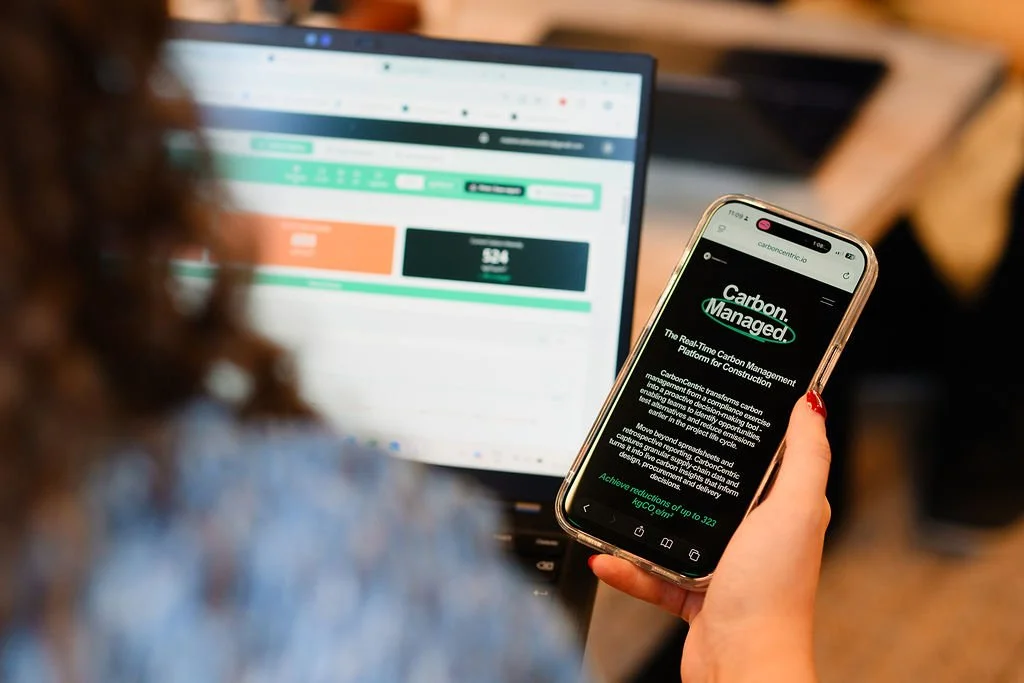
CarbonCentric combines a live carbon management platform with a team of experienced Life Cycle Assessment specialists.
The software provides the structure. It captures information, maintains an audit trail, tracks carbon budgets, highlights opportunities and gives project teams visibility of their carbon position as procurement develops.
Behind it sits a team that understands the data and, crucially, understands construction, including the rigour now expected following changes like the Building Safety Act and the renewed focus on sustainability.
Clients can choose the level of support that works for them.
Fully managed
For organisations that want the outcome without administering the process themselves, our LCA specialists can run CarbonCentric on your behalf.
We can:
Coordinate data collection
Review supplier information and check EPDs
Maintain the carbon position and identify hotspots
Investigate changes
Provide the reporting your project team needs
You get the benefit of live carbon management without building an internal carbon function.
Supported self-management
Other organisations already have capable sustainability, construction or consultancy teams and want to keep control of the process.
CarbonCentric can be administered directly by those teams, with our specialists providing arm’s-length technical support when needed. That might mean:
Reviewing difficult EPDs
Advising on unusual materials
Investigating a carbon variance
Answering methodology questions
Adding LCA capacity during busy periods
The expertise is there when you need it, without getting in the way of the team running the system.
The best model is people plus technology
We don’t see the future as consultants versus software, and we certainly don’t see it as people versus AI. The opportunity is to combine them.
Technology should remove administration.
Automation should show where attention is required.
AI should help interrogate information and surface opportunities.
Specialists should apply the judgement, context and experience to decide what happens next.
That combination matters more as carbon moves from a periodic assessment to something actively managed through design, procurement and construction.
Want to talk through which support model suits your team?
How Mainer can help
At Mainer, we help developers, housing providers, contractors, local authorities and asset owners use Whole Life Carbon Assessments to support better project outcomes.
Our work helps clients:
Strengthen planning submissions
Compare design and procurement options
Identify carbon hotspots
Support ESG and net zero reporting
Reduce uncertainty across the project life cycle
Whole Life Carbon Assessments are not just about understanding emissions.
They are about reducing risk, improving decisions and creating a stronger evidence base for the future.
Because when carbon is measured properly, it becomes more than a reporting requirement.
It becomes a tool for better project delivery.
Please click below for more information on Mainer’s Services:

LCA

EIA

BREEAM

Building Physics

Fitwel

Scope 3 Emissions

Planning Statements

ESG