
Sustainable Residential Development in the UK: Navigating Policy, Performance and Practice
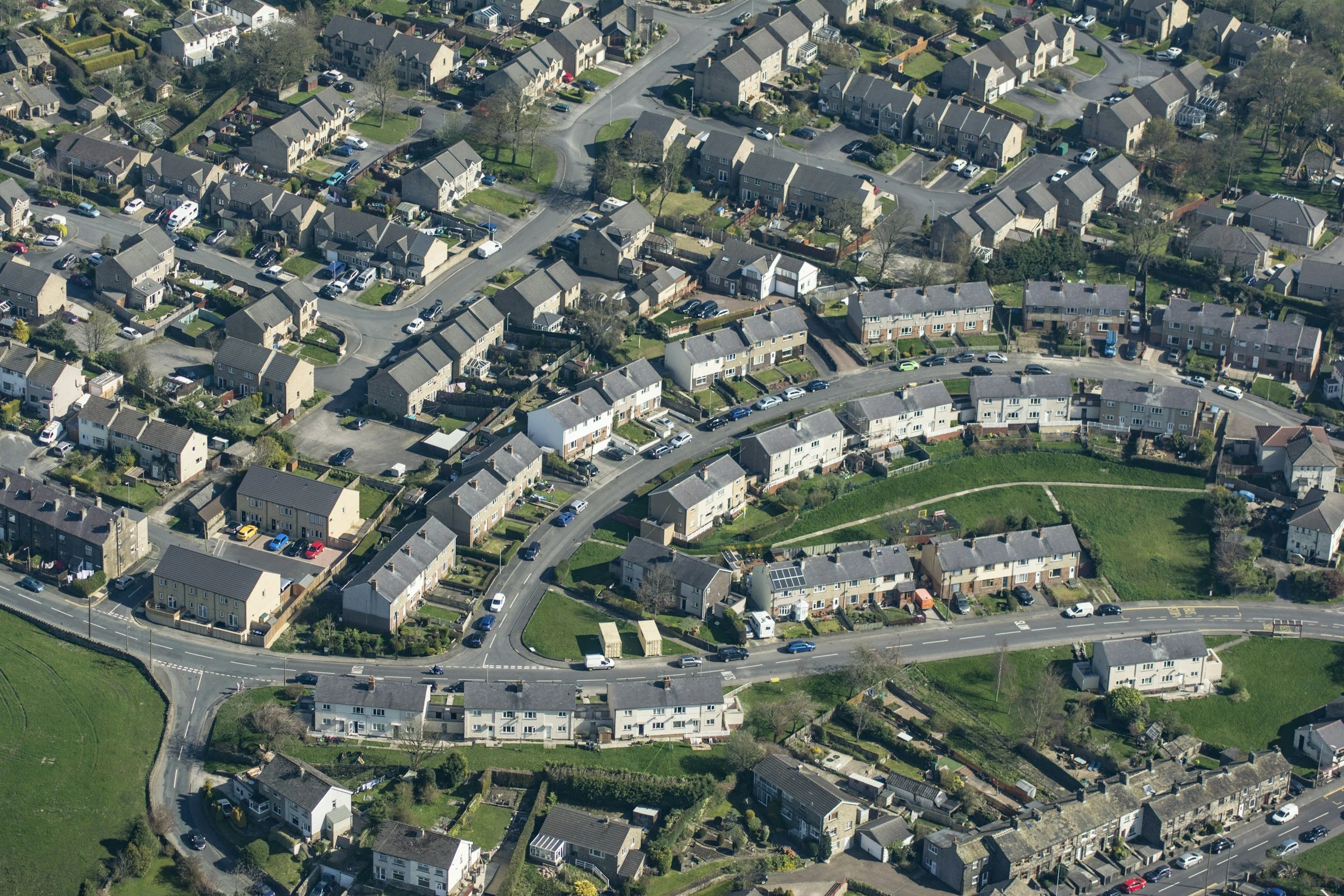
Sustainable housing in the UK is no longer a fringe ambition or optional upgrade - it has become central to planning success, investor confidence, and long-term community value. This article explores the key policy frameworks, design imperatives, and project-based innovations shaping the future of housing across the UK.
With the combined forces of the climate crisis and a deepening housing shortfall, the sector now operates under unprecedented regulatory, environmental, and economic pressures. As a result, sustainable development is being reshaped into a rigorous, data-led process, where design, construction, and operational performance must align with increasingly stringent policy frameworks.
At the forefront of this transformation are consultancies like Mainer Associates, supporting clients to meet, and often exceed, evolving expectations. Their approach spans early-stage feasibility to post-occupancy monitoring, helping to unlock value while de-risking delivery across all types of residential schemes.
Policy as the New Design Brief
Across the UK, policy has matured from vague environmental intentions into a precise, measurable set of mandates. The National Planning Policy Framework anchors the requirement for developments to mitigate and adapt to climate change, prioritising low-carbon approaches and reuse of brownfield land. In tandem, the Future Homes Standard - set for implementation in 2025 - will drive a fundamental shift in residential design by requiring homes to emit 75 to 80 percent less carbon than those built to 2013 regulations. This means no more gas boilers, fabric-first thermal performance, and systems fully compatible with the transition to electrified energy grids.

Alongside this, updates to the Building Regulations - especially Parts L and O - demand greater operational efficiency and design strategies to mitigate overheating. These amendments signal a clear policy trajectory: all new housing must be future-proofed against environmental, regulatory and investor risks. Moreover, with the UK’s legally binding Net Zero by 2050 target in place, residential construction must contribute quantifiable, permanent reductions in emissions.
These national frameworks are mirrored at the local level, where planning applications increasingly require detailed energy strategies, lifecycle carbon assessments, circular economy statements, and measurable carbon budget declarations. Post-occupancy energy reporting is also becoming an essential element of planning agreements. In this landscape, design teams must engage sustainability professionals from the outset. Waiting until later stages risks planning delays, missed funding opportunities, or reputational damage.
Manchester’s Ambition: From Strategy to Statute
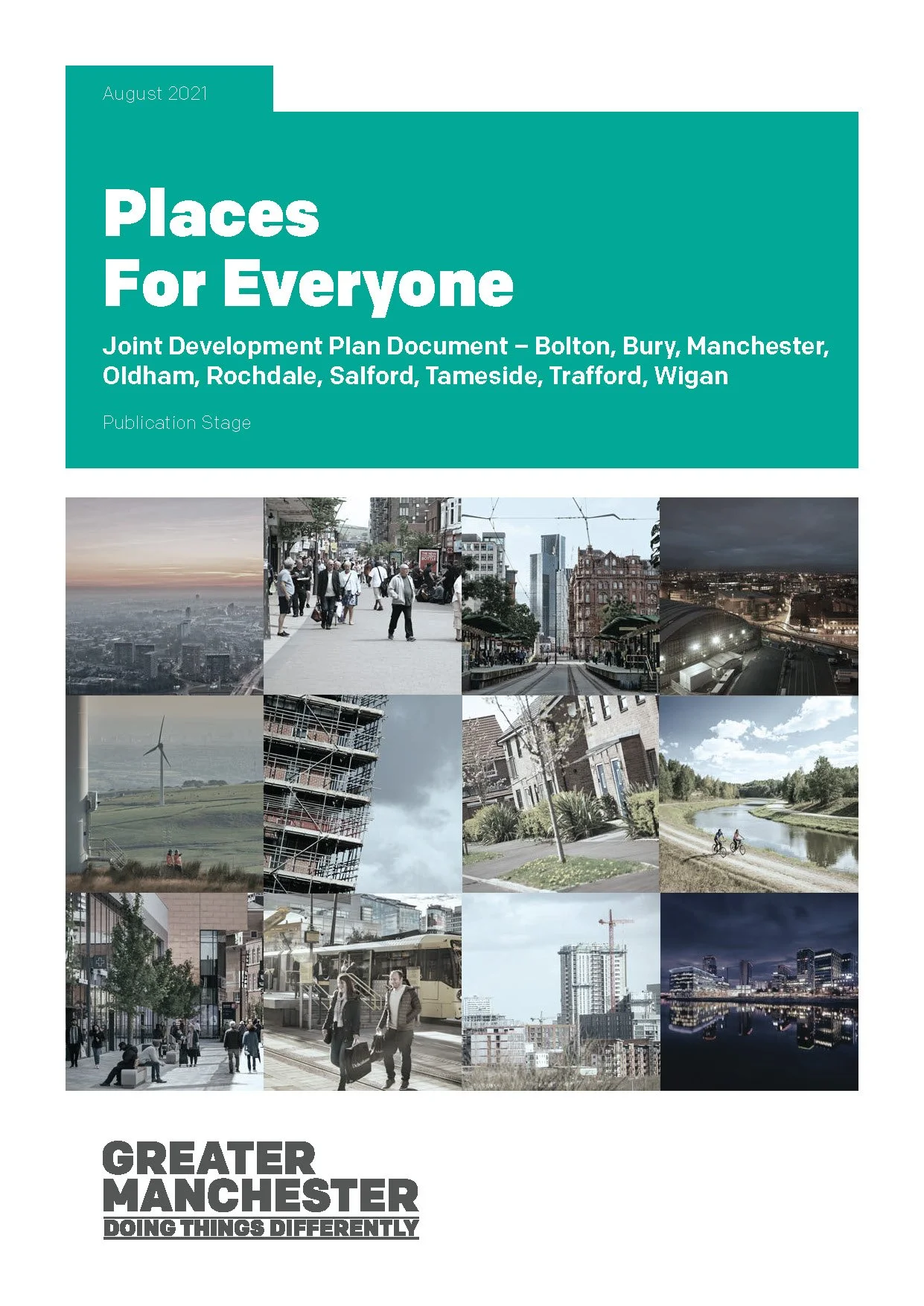
One of the most progressive examples of regional planning can be seen in the Places for Everyone (PfE) plan - a joint spatial framework adopted in March 2024 across nine Greater Manchester authorities. Designed to guide development through to 2039, the plan sets ambitious yet precise goals for housing, employment, and environmental quality.
Within the Manchester boundary alone, the plan outlines the construction of at least 60,000 homes and over two million square metres of office space. This expansion must adhere to core principles including brownfield prioritisation, revised green belt protections, and alignment with the city’s 2038 net zero carbon target. Environmental resilience is embedded throughout, from biodiversity net gain and air quality to flood risk and sustainable transport integration.
Perhaps most notably, Policy JP‑S2 within the PfE plan sets out a clear timeline for carbon compliance in new construction. From the date of adoption, all new buildings must achieve net zero operational carbon for regulated energy use. By 2025, this will extend to unregulated emissions, and by 2028, upfront embodied carbon from materials and construction will also be factored into compliance.
The policy signals a strong alignment with national frameworks like LETI and UKGBC, particularly in its adoption of energy use intensity (EUI) benchmarks. A target of 35 kWh per square metre per year - originally established for social housing - is now widely applied to all major schemes in the region. While no explicit numerical targets are imposed for embodied carbon, reporting and minimisation are mandatory. Designers are expected to demonstrate reductions using lifecycle carbon tools, material reuse strategies, and low-impact structural systems such as modular construction or engineered timber.
The case of the Robin Hood pub redevelopment in Stretford underscores the extent of Manchester’s ambition. Although technically a refurbishment, the creation of new dwellings within the existing structure triggers the same energy and carbon targets as a new build. Mainer Associates is working closely with planners to demonstrate compliance through both architectural design and embodied carbon reduction techniques.
Godley Green, Tameside
Godley Green: A Benchmark for What’s Possible
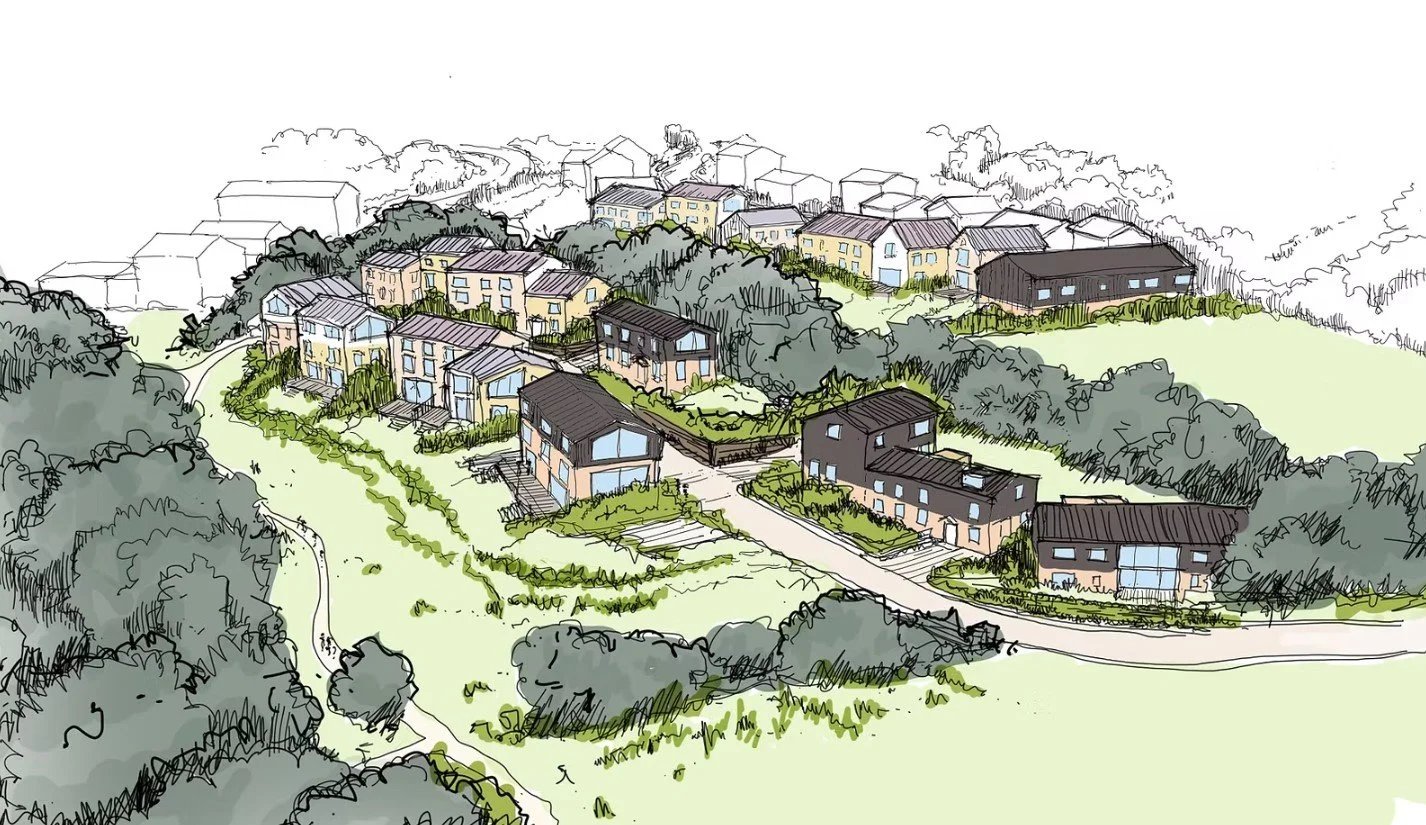
The emerging Godley Green Garden Village in Tameside is a live example of how this complex policy environment can be translated into long-term performance. This large-scale suburban expansion project has embraced sustainability from the earliest stages, making it a potential blueprint for other UK regions.
Mainer Associates led the creation of the Energy and Carbon Strategy for the project’s outline planning submission. The strategy was underpinned by passive design principles, a fabric-first approach, and a detailed analysis of district heating and grid integration options.
Their team also conducted embodied carbon assessments using the One Click LCA tool, ultimately demonstrating that cross-laminated timber construction could reduce embodied emissions by over 150 kgCO₂e per square metre compared to traditional brickwork systems. The resulting scheme is positioned not only to meet regulatory thresholds, but to attract institutional capital seeking evidence of climate resilience and lifecycle performance.
Raising the Bar Across the Sector
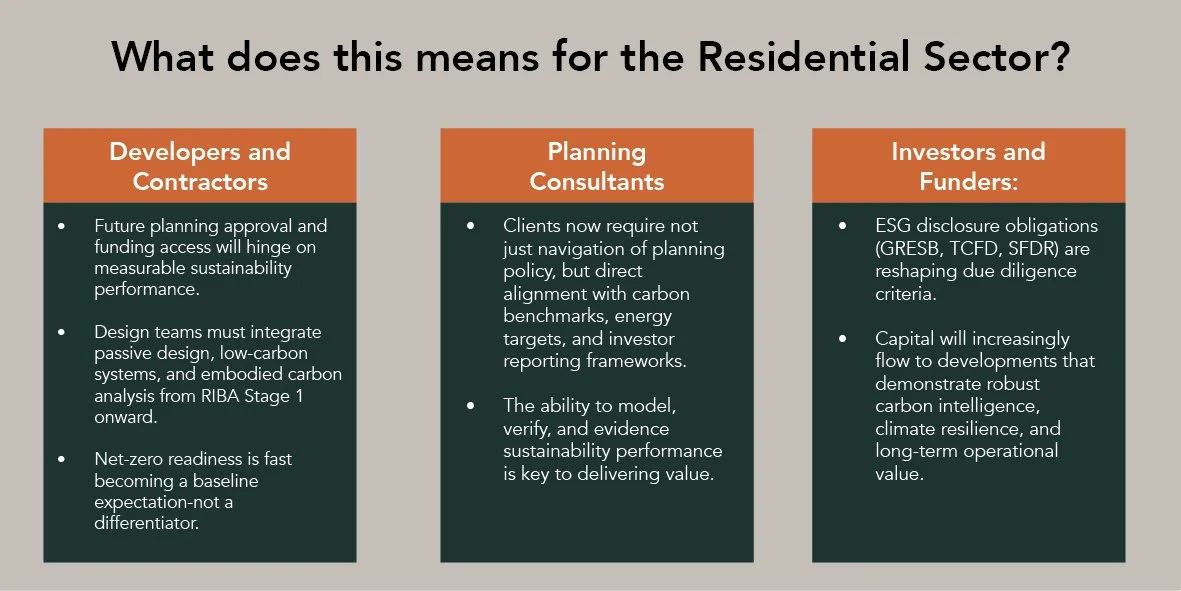
The expectations now placed on developers, consultants and investors go far beyond traditional design and planning deliverables. For developers and contractors, the ability to integrate passive design, carbon modelling, and electrification strategies from RIBA Stage 1 is now vital. Planning approval and funding depend on these elements being evidenced, not promised.
Planning consultants must evolve from policy interpreters into sustainability strategists, offering clients robust alignment with investor disclosure requirements such as GRESB, TCFD and SFDR. Delivering quantifiable outcomes in line with carbon budgets and energy targets is quickly becoming the primary driver of value and differentiation in the sector.
Meanwhile, investors and lenders are shifting capital toward projects that provide measurable carbon intelligence, climate resilience, and performance verification. Long-term value is increasingly seen through the lens of environmental compliance and operational reliability, not just cost and location.
Conclusion: Turning Policy into Performance with Mainer Associates
The future of housing in the UK will be defined not by promises, but by outcomes. At Mainer Associates, our role is to help clients make that leap - from policy alignment to high-performance delivery. We work across every stage of the development lifecycle to ensure that sustainable ambitions translate into measurable success.
If you are preparing for the Future Homes Standard, embarking on a retrofit, or planning a new residential scheme, the time to act is now. The tools, frameworks, and benchmarks exist - what’s needed is the capability to implement them confidently and coherently.
Need help on a residential scheme?
To learn more about how we can help on your next residential scheme, visit our Residential page or Get in touch today to ensure your next project not only meets expectations, but sets the standard.
Please click below for more information on Mainer’s Services:

LCA

EIA

BREEAM

Building Physics

Fitwel

Scope 3 Emissions

Planning Statements

ESG