
Why EC3 Matters: Unlocking Real Carbon Reduction in Construction

The construction industry sits at the centre of the climate challenge. Globally, buildings and infrastructure account for nearly 40% of carbon emissions, and a growing share of that impact comes not only from how buildings operate, but from how they are created in the first place.
As operational energy becomes cleaner through cleaner grids, renewables and efficiency standards, embodied carbon-the emissions locked into materials like concrete, steel, and insulation before a building is ever used-has become the next major frontier for decarbonisation.
Despite its importance, embodied carbon has historically been difficult to measure, compare, and reduce in a meaningful way. The desire across the industry for this level of carbon management, is arguably a post- Covid pandemic global action. This is where EC3 and management tools like CarbonCentric, can change everything.
What Is EC3?
EC3 stands for Embodied Carbon in Construction Calculator. It is the world’s leading database and comparison tool for embodied carbon in construction materials.

At its core, EC3 provides access to tens of thousands of Environmental Product Declarations (EPDs)-independently verified documents published by manufacturers that quantify the environmental impact of a specific product. These include precise measurements such as:
kg CO₂e per cubic metre of concrete
kg CO₂e per tonne of steel
kg CO₂e per square metre of insulation, cladding, or plasterboard
In simple terms, EC3 tells you how much carbon is in real construction products, using real manufacturer data-not generic averages or assumptions.
EC3 allows project teams to benchmark materials, compare products like-for-like, and identify best-in-class low-carbon options that already exist in the market today.
Why Embodied Carbon Is So Hard to Tackle
Traditionally, carbon calculations in construction have relied on industry-average datasets. While these are useful for high-level assessments, they mask enormous variation at the product level.
For example, two concrete mixes may meet the same structural specification and cost roughly the same-but one could carry 50–60% more embodied carbon than the other due to cement content, production methods, or supply-chain efficiency.
Without product-specific data:
Designers cannot see the impact of their material choices
Contractors default to familiar suppliers
Carbon targets are set but not actively managed
Opportunities for reduction are missed entirely
In short, you cannot reduce what you cannot see.
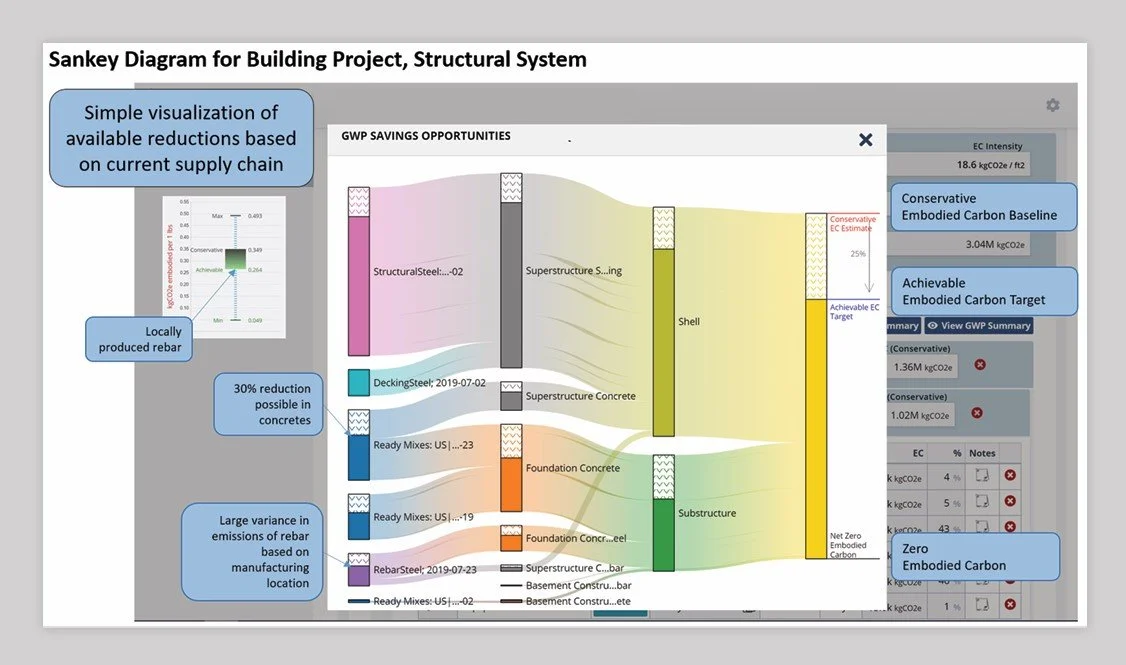
How EC3 Enables Real Carbon Reduction
EC3 brings transparency and comparability to embodied carbon, unlocking reductions that were previously invisible.
1. From Generic Averages to Real Products
EC3 replaces broad assumptions with verified, manufacturer-specific data. This allows teams to move beyond “good enough” estimates and make informed decisions based on what is actually being supplied to site.
2. Benchmarking That Drives Better Choices
One of EC3’s most powerful features is its ability to benchmark products against each other. Users can instantly see:
Best-in-class products
Market averages
High-carbon outliers
This visibility alone often leads to substantial reductions, as teams realise that lower-carbon alternatives are already available and compliant with performance requirements.
3. Early-Stage Influence Where It Matters Most
The majority of embodied carbon is locked in during early design and specification. EC3 enables carbon intelligence at precisely the moment when decisions are still flexible-rather than reporting emissions after materials are already procured.
4. Supply-Chain-Driven Decarbonisation
By highlighting which products outperform benchmarks, EC3 shifts pressure upstream. Manufacturers are incentivised to publish EPDs and reduce emissions, knowing their products will be compared transparently in competitive procurement processes.
This creates market-driven decarbonisation, not theoretical reductions on paper.
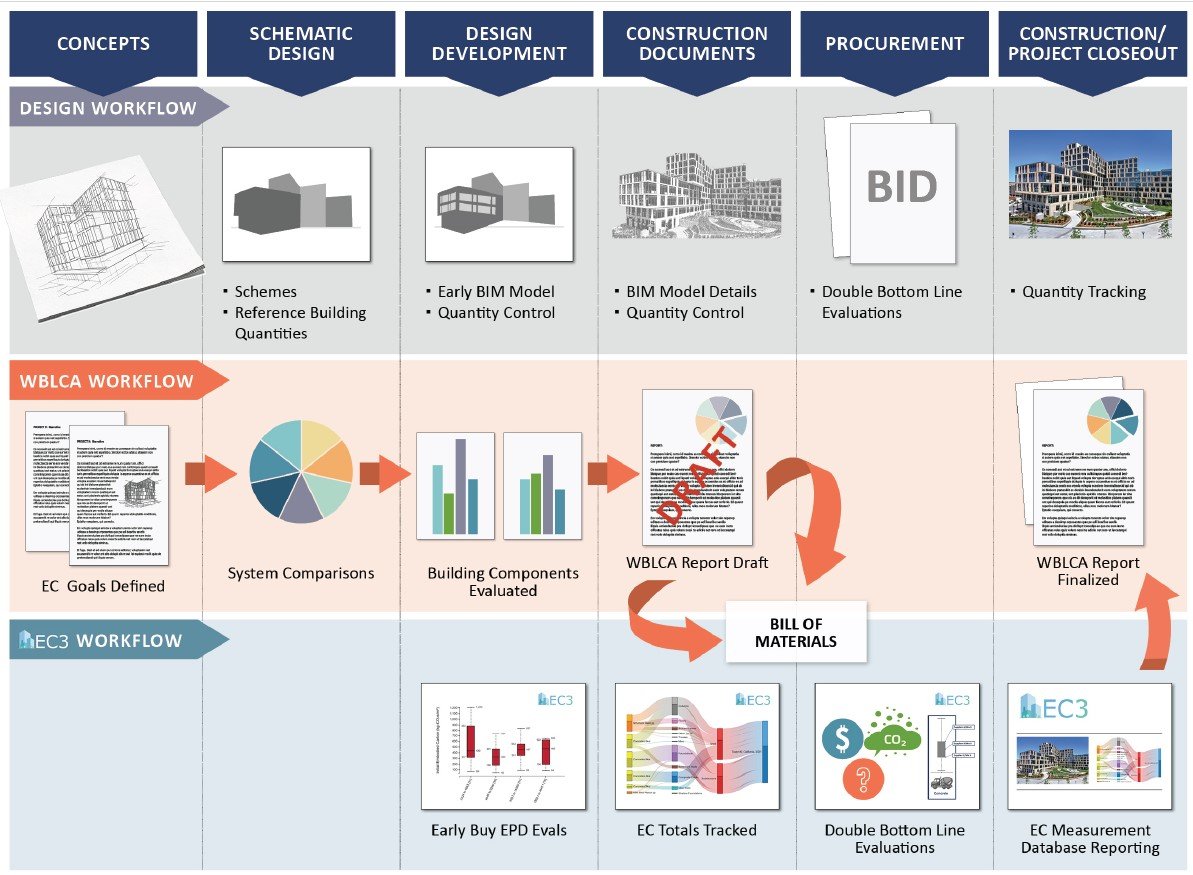
The EC3 Tool Flow Chart - Image Source: Magnusson Klemencic Associates | MKA - Seattle
Why EC3 Is Becoming Essential, Not Optional
Regulation, finance, and client expectations are rapidly evolving. Across the UK, Europe, and globally, planning authorities, investors, and certification schemes are increasingly demanding product-specific embodied carbon data.
Standards such as Whole Life Carbon assessments, RICS guidance, LETI targets, BREEAM, NABERS, and net-zero frameworks all point in the same direction:
generic data is no longer enough.
EC3 provides:
Independently verified, audit-ready data
Traceability for ESG and carbon disclosure
Confidence that reported reductions are real and defensible
For developers, designers, and contractors, this is becoming a prerequisite for winning planning approvals, securing green finance, and meeting client carbon commitments.
Turning Data into Action
While EC3 is a powerful tool on its own, its real value is unlocked when embedded into the workflows where decisions are made.
Embodied carbon reduction should not be a separate exercise carried out by specialists at the end of a project. It needs to be:
Integrated into design
Embedded in procurement
Aligned with commercial decision-making
This is where platforms like CarbonCentric play a critical role-connecting EC3’s product-level intelligence directly into project-level carbon management.
By integrating EC3 data into a unified platform, teams can move from passive reporting to active carbon optimisation: identifying hotspots, testing alternatives, engaging suppliers, and demonstrating measurable reductions throughout the project lifecycle.
A New Standard for Low-Carbon Construction
The construction industry already has many of the solutions it needs to reduce embodied carbon. The challenge has never been a lack of intent-it has been a lack of visibility.
EC3 provides that visibility.
It reveals the carbon impact hidden inside everyday materials, empowers better choices, and aligns the supply chain around measurable performance rather than marketing claims.
As embodied carbon becomes one of the defining metrics of sustainable construction, EC3 is quickly moving from “nice to have” to industry essential.
And as tools like CarbonCentric integrate EC3 directly into carbon management workflows, the path from data to decision-and from ambition to action-has never been clearer.
If you’d like to see how CarbonCentric can be used as the carbon management platform for your next project, email hello@mainer.co.uk and we’ll organise a demonstration.
Please click below for more information on Mainer’s Services:

LCA

EIA

BREEAM

Building Physics

Fitwel

Scope 3 Emissions

Planning Statements

ESG