

A few years ago, sustainability reporting was largely viewed as a specialist exercise.
Today, it's a boardroom conversation.
Investors want evidence. Regulators expect transparency. Clients increasingly ask for measurable environmental performance. And organisations across the built environment are under growing pressure to demonstrate how they are progressing towards net zero commitments.
The challenge isn't a lack of ambition, it's a lack of meaningful data.
Because while many organisations have established sustainability targets, understanding where emissions occur—and how to reduce them—remains far more complex.
This is where Whole Life Carbon Assessments (WLCA) are becoming increasingly valuable.
Not simply as a technical exercise, but as a practical tool for strengthening ESG reporting, supporting net zero strategies and improving decision-making across the asset life cycle.
The Shift from Commitments to Evidence
Most organisations now have some form of sustainability strategy.
Net zero roadmaps, carbon reduction plans and ESG frameworks have become increasingly common across the built environment.
The next challenge is proving progress.
Stakeholders are becoming more sophisticated in the questions they ask:
How are emissions being measured?
Which emissions sources are included?
What reduction strategies are being implemented?
How are investment decisions supporting carbon objectives?
Increasingly, broad statements about sustainability are no longer enough.
Organisations need evidence.
And evidence requires data.
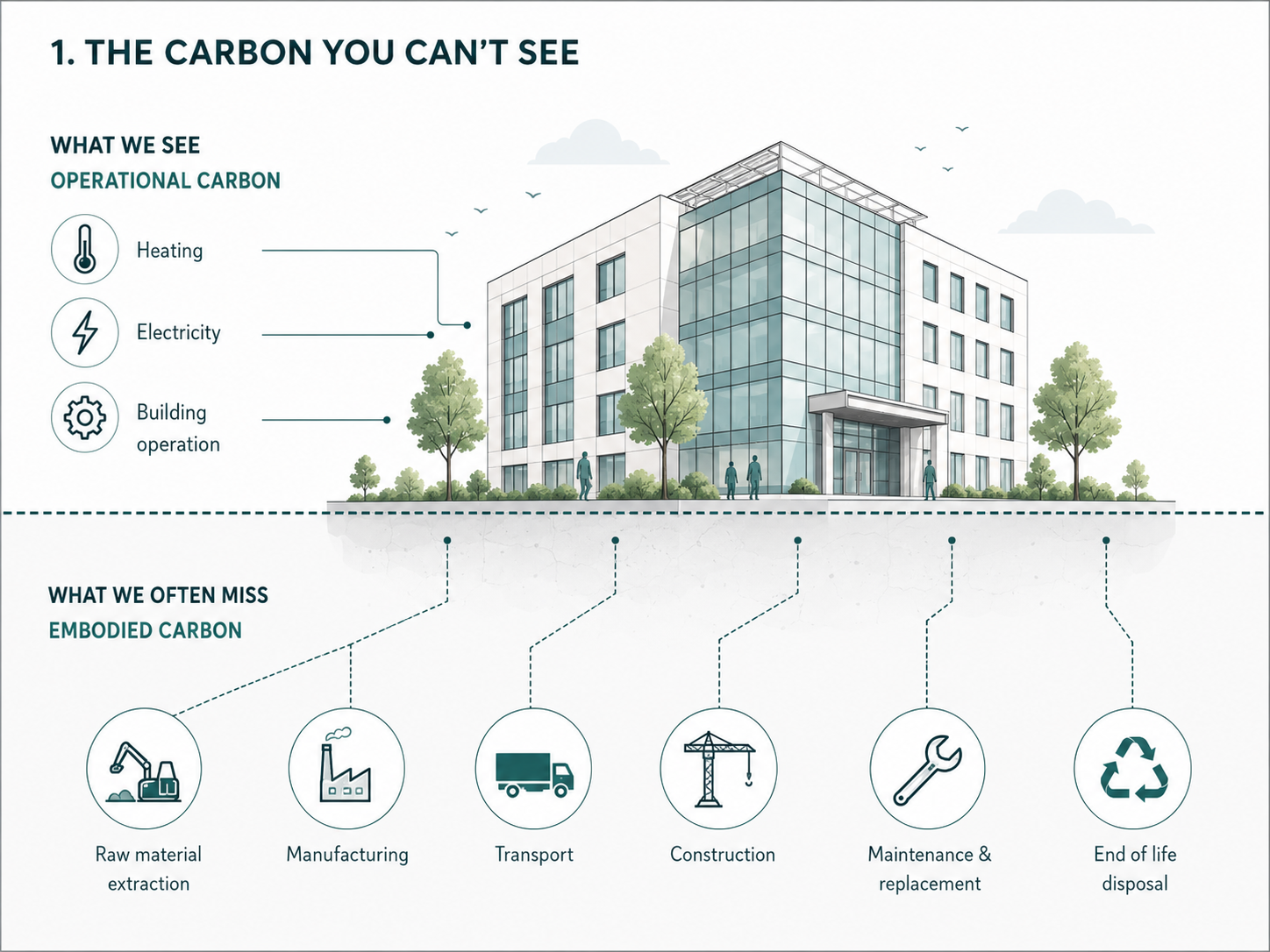
Understanding the Carbon You Can't See
When people think about building emissions, they often think about energy use.
Heating systems.
Electricity consumption.
Building management systems.
These operational emissions remain important, but they only tell part of the story.
A significant proportion of carbon emissions can occur before a building is ever occupied.
These embodied carbon emissions are associated with:
Material extraction
Manufacturing
Transportation
Construction
Maintenance and replacement
End-of-life disposal
For many projects, these impacts can represent a substantial share of total life cycle emissions.
Without measuring them, organisations may only be reporting part of their carbon footprint.
Why This Matters for ESG Reporting
Environmental, Social and Governance reporting is increasingly focused on transparency and accountability.
Investors, stakeholders and clients want a more complete understanding of environmental impacts.
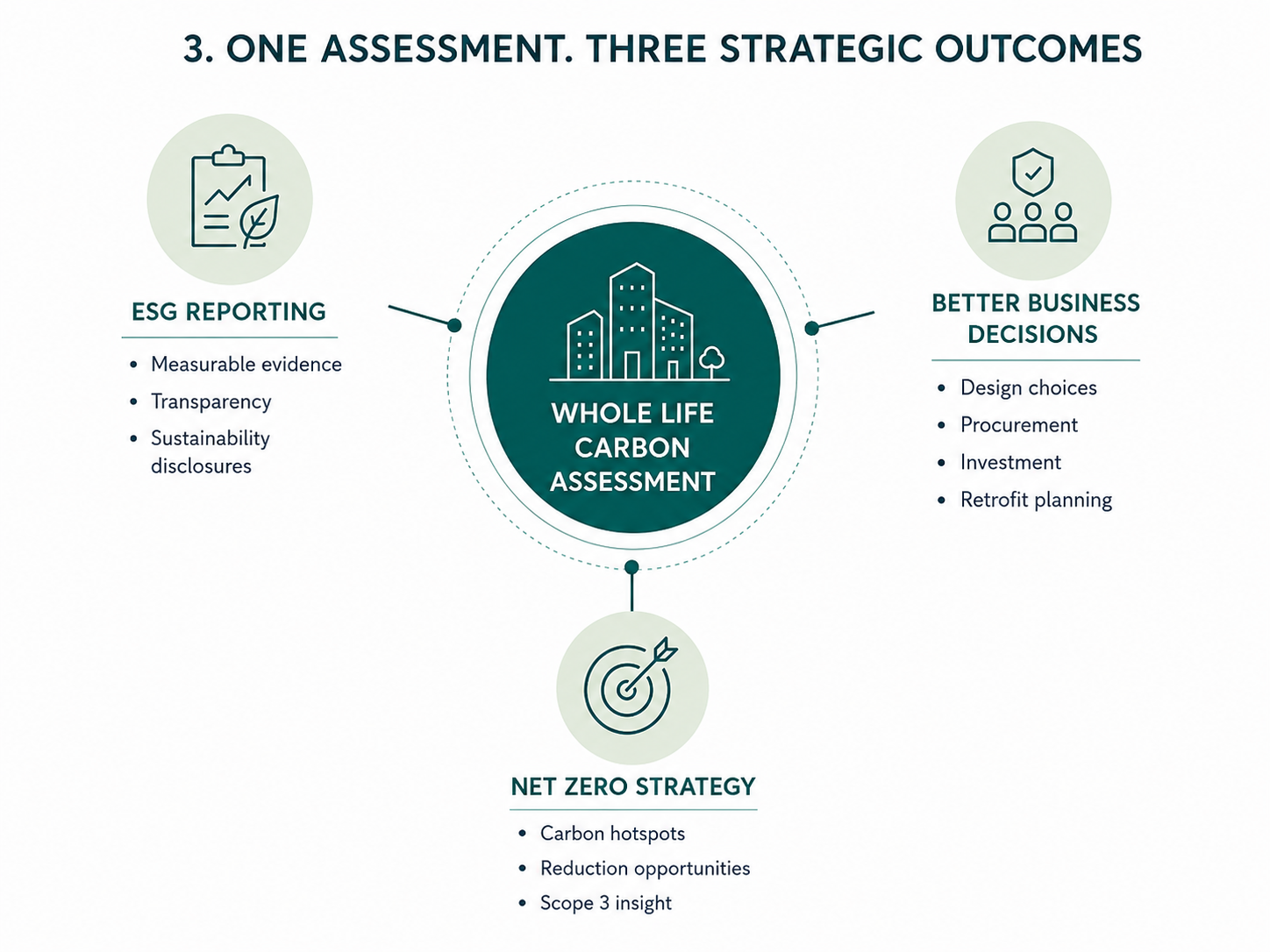
A Whole Life Carbon Assessment helps organisations move beyond high-level sustainability statements by providing measurable, project-specific carbon data.
This enables organisations to:
Quantify life cycle emissions
Demonstrate carbon reduction efforts
Compare project options
Support sustainability disclosures
Track performance over time
Most importantly, it allows sustainability claims to be supported by evidence.
That's becoming increasingly important in an environment where stakeholders expect greater scrutiny and accountability.
Addressing Scope 3 Emissions
One of the biggest challenges facing organisations pursuing net zero is Scope 3 emissions.
These indirect emissions often represent the largest and most difficult-to-measure component of an organisation's carbon footprint.
Within the built environment, Scope 3 emissions can include:
Purchased materials
Supply chain activities
Construction processes
Asset life cycle impacts
Whole Life Carbon Assessments provide valuable insight into many of these areas.
By understanding embodied carbon and life cycle emissions, organisations can begin identifying where meaningful reductions can be achieved across the wider value chain.
This transforms carbon reporting from a retrospective exercise into a strategic planning tool.
Supporting Net Zero Strategies
Net zero commitments are increasingly common.
Delivering them is considerably harder.
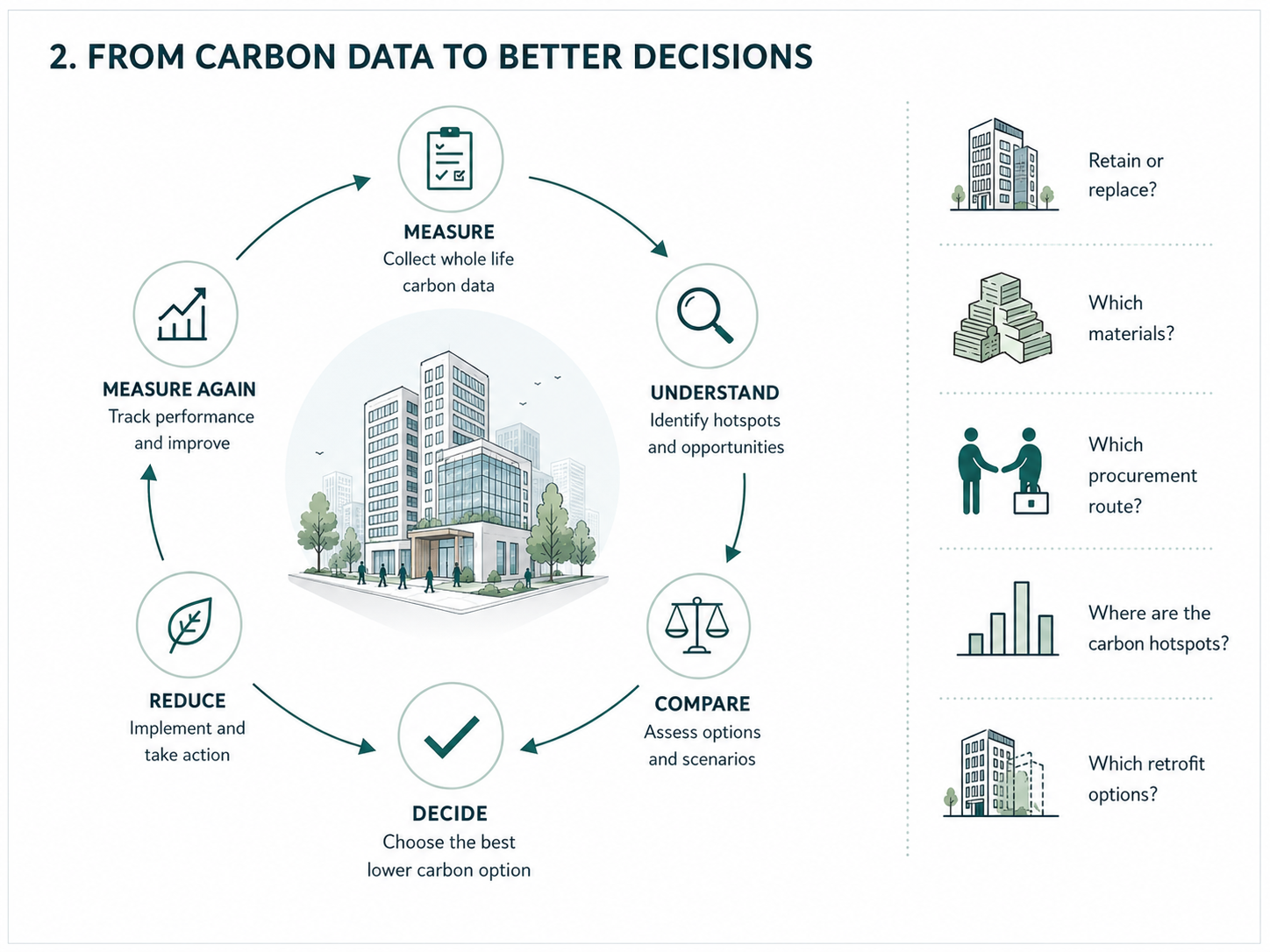
The reality is that meaningful carbon reduction requires informed decision-making at every stage of a project's life cycle.
Questions such as:
Should an asset be retained or replaced?
Which materials offer lower carbon alternatives?
How can procurement decisions reduce emissions?
Where are the biggest carbon hotspots within a project?
Cannot be answered effectively without reliable data.
A Whole Life Carbon Assessment provides the evidence required to understand these trade-offs and identify opportunities for improvement.
Rather than focusing solely on reporting historic emissions, organisations can use carbon data to influence future outcomes.
Better Decisions, Not Just Better Reports
One of the most common misconceptions about carbon assessments is that they exist primarily for compliance purposes.
In practice, their greatest value often lies elsewhere.
The organisations making the greatest progress towards their sustainability objectives are using carbon information to shape decisions before projects are delivered.
They are using life cycle carbon data to:
Evaluate design options
Inform investment decisions
Prioritise retrofit programmes
Improve procurement strategies
Identify carbon reduction opportunities early
The reporting benefits are important.
But the strategic value often extends far beyond reporting itself.
ESG Performance Is Becoming a Competitive Advantage
Environmental performance is no longer viewed solely as a compliance issue.
Increasingly, it influences:
Funding opportunities
Investment decisions
Procurement processes
Stakeholder confidence
Organisational reputation
Clients and investors want confidence that sustainability commitments are supported by credible evidence and measurable action.
Whole Life Carbon Assessments provide one of the most effective ways of demonstrating that commitment within the built environment.
By quantifying life cycle impacts and identifying reduction opportunities, organisations can strengthen both sustainability performance and stakeholder confidence.
Whole Life Carbon Is Becoming Business as Usual
The direction of travel across the industry is clear.
Carbon transparency is increasing.
Reporting expectations are growing.
Net zero targets are becoming more ambitious.
As this continues, organisations will need increasingly sophisticated tools to understand and manage their environmental impact.
Whole Life Carbon Assessments provide a practical framework for doing exactly that.
Not because organisations need another report.
But because they need better information.
And better information leads to better decisions.
How Mainer Can Help
At Mainer, we support developers, housing providers, contractors, local authorities and asset owners in understanding the carbon impacts of their projects and portfolios.
Our Whole Life Carbon Assessment services help organisations:
Quantify life cycle emissions
Support ESG reporting requirements
Inform net zero strategies
Compare design and procurement options
Identify practical carbon reduction opportunities
Most importantly, we help turn carbon data into actionable insight.
Because successful sustainability strategies aren't built on ambition alone.
They're built on evidence, informed decisions and measurable progress.
Looking to strengthen your ESG reporting or support your net zero strategy with robust carbon data? Speak to Mainer about our Whole Life Carbon Assessment services.
Please click below for more information on Mainer’s Services:

LCA

EIA

BREEAM

Building Physics

Fitwel

Scope 3 Emissions

Planning Statements

ESG