
Retrofit vs Rebuild: What is the Carbon Cost of This Decision?

When an existing building reaches the point where significant investment is required, the conversation usually starts in a familiar place.
"Can it be saved? or would we be better off starting again?"
For decades, the answer has often been driven by cost, condition, programme, or operational performance. If a new building promised greater efficiency, improved functionality and lower running costs, demolition and rebuild frequently became the preferred option.
But there's a growing recognition across the built environment that another question needs to be asked.
What is the Carbon Cost of That Decision?
As organisations work towards net zero targets and face increasing scrutiny around environmental performance, the choice between retrofit and rebuild is no longer just a financial one.
It's a carbon decision too and the answer is rarely as straightforward as people expect.
This has been a key question on our project The Langfield.
Originally setting out to retain both a North and South building, the project team were challenged by the existing condition of the south building following extensive surveys and initial strip-out, ultimately having to demolish greater amounts of the building than initially anticipated.
With estimated embodied carbon performance and targets based on full retention, the project team were challenged to re-assess the carbon impacts of greater demolition and new build materials, whilst minimising additional embodied carbon over original estimates. Despite the increased demolition, the project’s embodied carbon still had to be within acceptable limits with the local planning authority.
The Carbon We Can See - and the Carbon We Can't
Most discussions around building sustainability focus on operational carbon.
How much energy will the building use?
How efficient will the heating system be?
Will the building meet current energy standards?
These are all important considerations.
However, focusing solely on operational performance can sometimes overlook a significant part of the picture.
Embodied carbon.
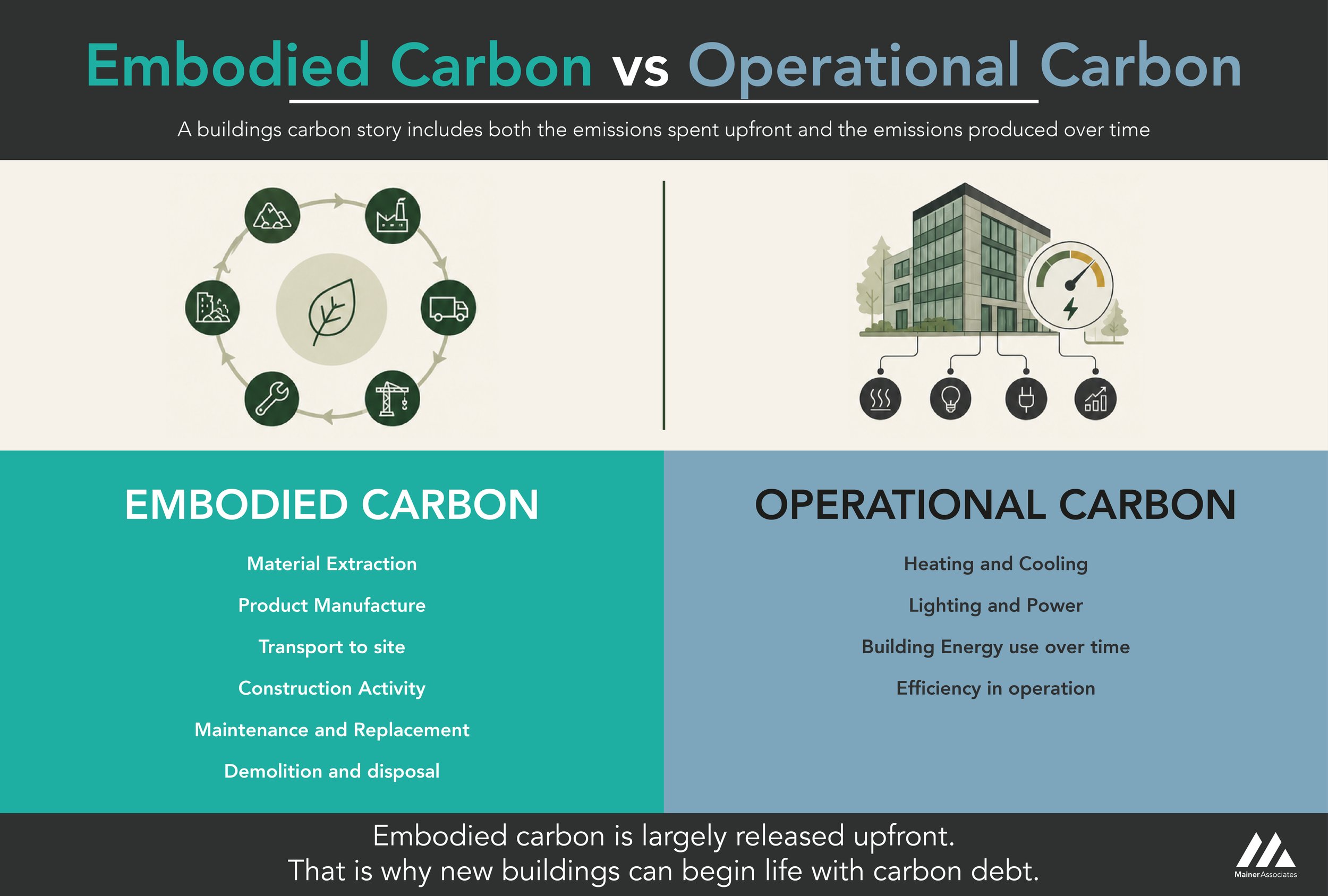
Embodied carbon includes the emissions generated through:
Extracting raw materials
Manufacturing construction products
Transportation
Construction activities
Maintenance and replacement
Demolition and disposal
Unlike operational emissions, most of the embodied carbon is released upfront.
Once a building is demolished and rebuilt, much of a project’s embodied carbon expenditure is already spent. Which means that even highly efficient new buildings can begin life with a substantial carbon debt.
Why New Isn't Always Better
There's a common assumption that newer buildings are automatically more sustainable.
After all, modern buildings are designed to higher environmental standards and often consume significantly less energy during operation.
But sustainability is about more than operational efficiency.
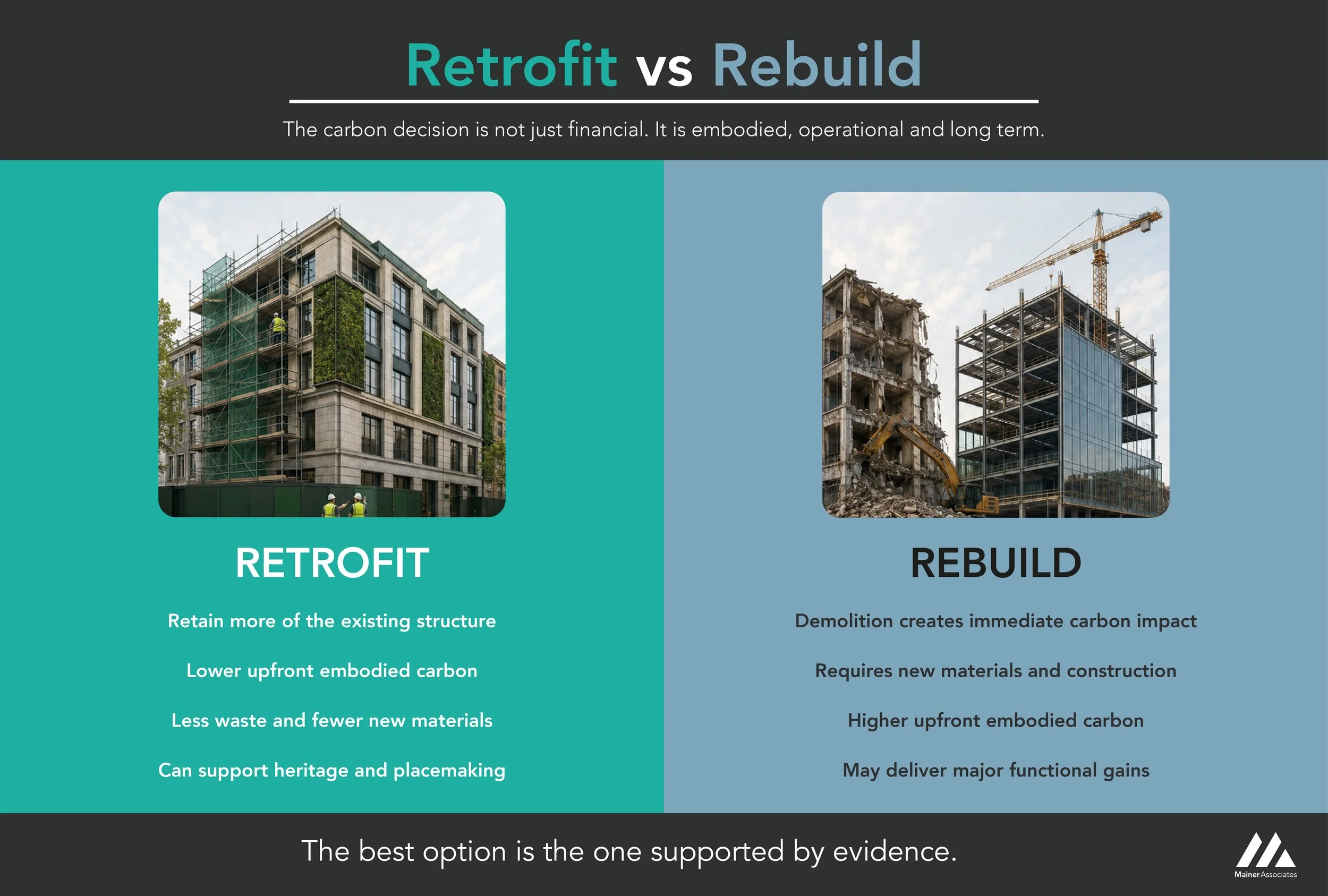
Demolishing an existing structure means:
Sending materials to waste streams
Replacing structural elements
Manufacturing new products
Transporting materials to site
Constructing a new asset from the ground up
All these activities generate carbon emissions.
In some cases, the embodied carbon associated with rebuilding can take decades to offset through operational savings.
That's why many organisations are now looking more carefully at what can be retained rather than replaced.
The Case for Retrofit
Retrofit offers a different approach, rather than starting again, it seeks to improve the performance, functionality and lifespan of an existing asset.
From a carbon perspective, one of its greatest advantages is simple:
The sustainable building is often the one that already exists.
Retaining existing structures can significantly reduce embodied carbon by avoiding the emissions associated with new construction.
Potential benefits include:
Reduced material consumption
Lower construction-related emissions
Less waste generation
Preservation of existing carbon investment
Faster project delivery in some cases
For housing providers, local authorities and commercial asset owners, retrofit can also align with wider objectives around placemaking, heritage preservation and community continuity.
But retrofit isn't automatically the lowest-carbon option in every scenario.
When Rebuild May Still Make Sense
Not every building can or should be retained.
There are situations where rebuilding may deliver stronger long-term outcomes.
For example:
Assets with severe structural issues
Buildings that cannot be economically upgraded
Facilities with fundamentally unsuitable layouts
Projects requiring significant increases in capacity or functionality
In these cases, operational performance gains may be substantial enough to justify the additional embodied carbon investment.
The key point is that assumptions should not drive the decision.
Evidence should.
Why Whole Life Carbon Assessments Matter
This is where Whole Life Carbon Assessments become invaluable.
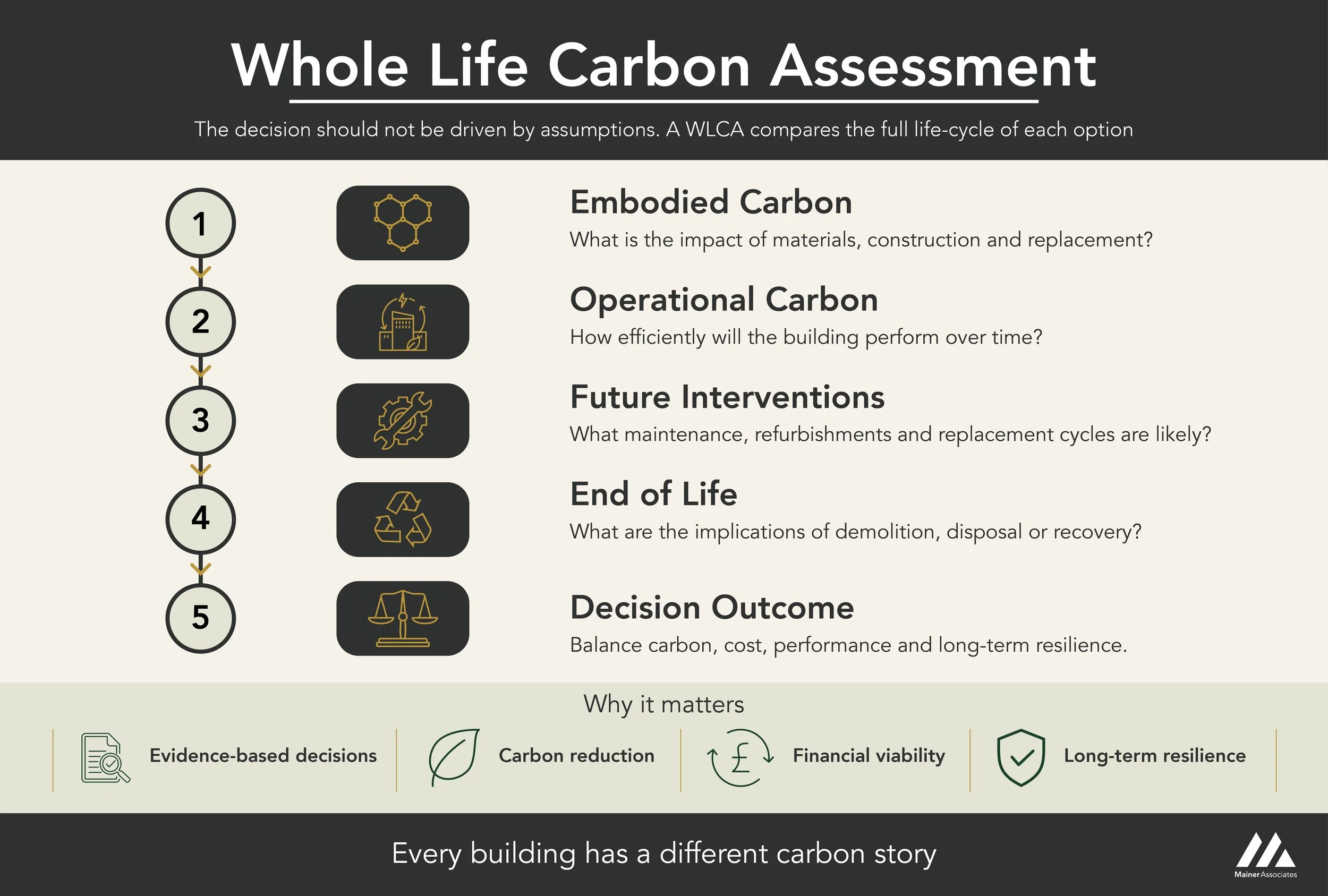
Rather than relying on generalisations, a WLCA provides a structured comparison of both options.
It allows project teams to assess:
Embodied carbon impacts
Operational carbon performance
Replacement cycles
Future refurbishments
Maintenance requirements
End-of-life implications
Most importantly, it quantifies the carbon implications of each scenario.
Because every building is different.
A 1960s office block will present different challenges and opportunities to a Victorian housing stock asset or a post-war education facility.
What works in one case may not work in another.
A robust carbon assessment helps organisations understand those differences and make informed decisions accordingly.
Looking Beyond Carbon Alone
Carbon is increasingly important, but it shouldn't be viewed in isolation.
The most successful asset strategies balance multiple priorities, including:
Carbon reduction
Financial viability
Building performance
User experience
Regulatory compliance
Long-term resilience
A Whole Life Carbon Assessment should form part of a wider decision-making framework rather than acting as a standalone measure.
The goal isn't simply to find the lowest carbon number.
It's to identify the option that delivers the best overall outcome.
The Industry Shift Is Already Underway
Across the UK, we're seeing growing recognition that retaining and improving existing assets will play a critical role in achieving net zero ambitions.
The scale of the challenge facing the built environment means that carbon reduction cannot be achieved through, new, more operationally efficient buildings.
Existing buildings represent an enormous opportunity.
For many organisations, the question is no longer whether carbon should influence asset decisions.
It's how to incorporate carbon considerations alongside operational, financial and social objectives.
Those that can successfully balance all four will be best positioned to meet future expectations.
The Best Option? The One Supported by Evidence
The debate between retrofit and rebuild is often framed as a choice between old and new.
In reality, it's a question of understanding trade-offs.
Every project has unique constraints.
Every asset has a different carbon story.
And every organisation has different priorities.
That's why the answer should never be based on assumptions, trends or rules of thumb.
It should be based on evidence.
A robust Whole Life Carbon Assessment provides the insight needed to understand the full impact of both options and make decisions with confidence.
Because when it comes to carbon, what appears to be the obvious choice isn't always the right one.
How Mainer Can Help
Whether you're considering a refurbishment programme, estate rationalisation strategy or new development, understanding the carbon implications of your options is becoming increasingly important.
At Mainer, we help clients evaluate retrofit and rebuild scenarios through robust Whole Life Carbon Assessments that support better decision-making.
By quantifying life cycle impacts and identifying carbon reduction opportunities, we help organisations balance sustainability objectives with commercial realities.
Because informed decisions deliver better outcomes - for projects, portfolios and the planet.
Contact us at hello@mainer.co.uk about how a Whole Life Carbon Assessment can support your project objectives.
Please click below for more information on Mainer’s Services:

LCA

EIA

BREEAM

Building Physics

Fitwel

Scope 3 Emissions

Planning Statements

ESG