
Alan Milburn’s report has now been followed by government commitments to change how young people are supported into work.
His report - which has now been published in full - says the UK should aim to reduce the rate of Neet young people from 13% to about 5% by 2036.
At Mainer Associates, we’ve seen first-hand what can happen when young people are given a genuine opportunity.
A Case for Shifting the Balance
With nearly one million young people outside education, employment or training, the findings point to a fragmented system that too often intervenes late. The government has accepted the need to bring employment, skills, health and practical support together around the individual.
The commitments now include:
From spring 2027, making guaranteed, fully funded six-month jobs available after 12 months of unemployment, rather than 18.
An Opportunity and Support Guarantee, providing routes into education, training, apprenticeships, quality work experience or employment, alongside support to participate.
Locally led youth services, beginning next year, bringing disconnected support together.
Alan Milburn will chair a new Youth Opportunities Unit reporting directly to the Prime Minister. Detailed welfare proposals will follow in a White Paper in early 2027, considered alongside the Timms Review. These announcements do not mean every recommendation has been adopted.

What opportunity looks like in practice
At Mainer Associates, we have used initiatives such as Kickstart to offer paid work and training. We established the Mainer Academy in 2022 to give graduates practical experience on live sustainability projects.

Our Academy article described Joe qualifying as a BREEAM assessor and contributing to Outstanding-rated buildings, while Mark developed his whole life carbon skills and also helped to develop CarbonCentric our real-time carbon management platform for construction
Link to our Mainer Academy article
Our new graduates start their journey to a sustainable future
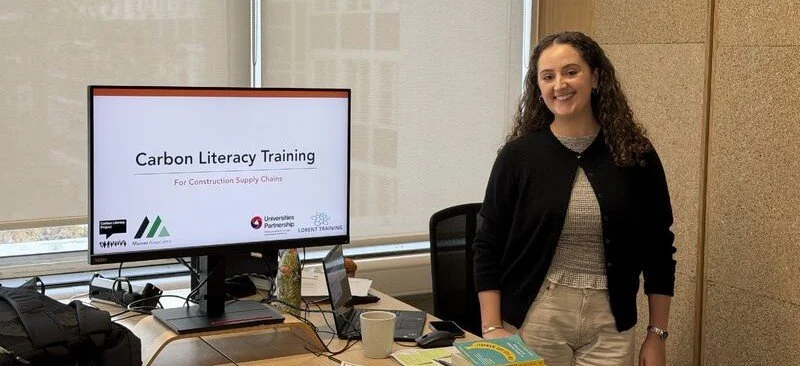
Lucy Summerell is now an important part of Mainer, CarbonCentric and our work as Carbon Literacy course providers.
Lucy has also just delivered her first Carbon Literacy course to the Mainer Associates team.
Employers ask for experience, but someone has to provide that first chance.
Who needs to do what
Government funding can help. Businesses must contribute meaningful work, supervision and progression. Smaller employers need accessible schemes that recognise the time involved in developing someone properly.
The government has also committed to maintaining a safety net for those unable to work. Practical opportunity and appropriate financial support must work together.
Success should be measured in sustained employment, growing confidence and careers built.
For our sector, that also means developing the people needed for a sustainable built environment and a just transition to a low carbon economy.
That is the benefit of opportunity.
How Mainer can help
At Mainer, we help developers, housing providers, contractors, local authorities and asset owners use Whole Life Carbon Assessments to support better project outcomes.
Our work helps clients:
Strengthen planning submissions
Compare design and procurement options
Identify carbon hotspots
Support ESG and net zero reporting
Reduce uncertainty across the project life cycle
Whole Life Carbon Assessments are not just about understanding emissions.
They are about reducing risk, improving decisions and creating a stronger evidence base for the future.
Because when carbon is measured properly, it becomes more than a reporting requirement.
It becomes a tool for better project delivery.
Please click below for more information on Mainer’s Services:

LCA

EIA

BREEAM

Building Physics

Fitwel

Scope 3 Emissions

Planning Statements

ESG