
What is a WLCA and why are more organisations being asked for one?
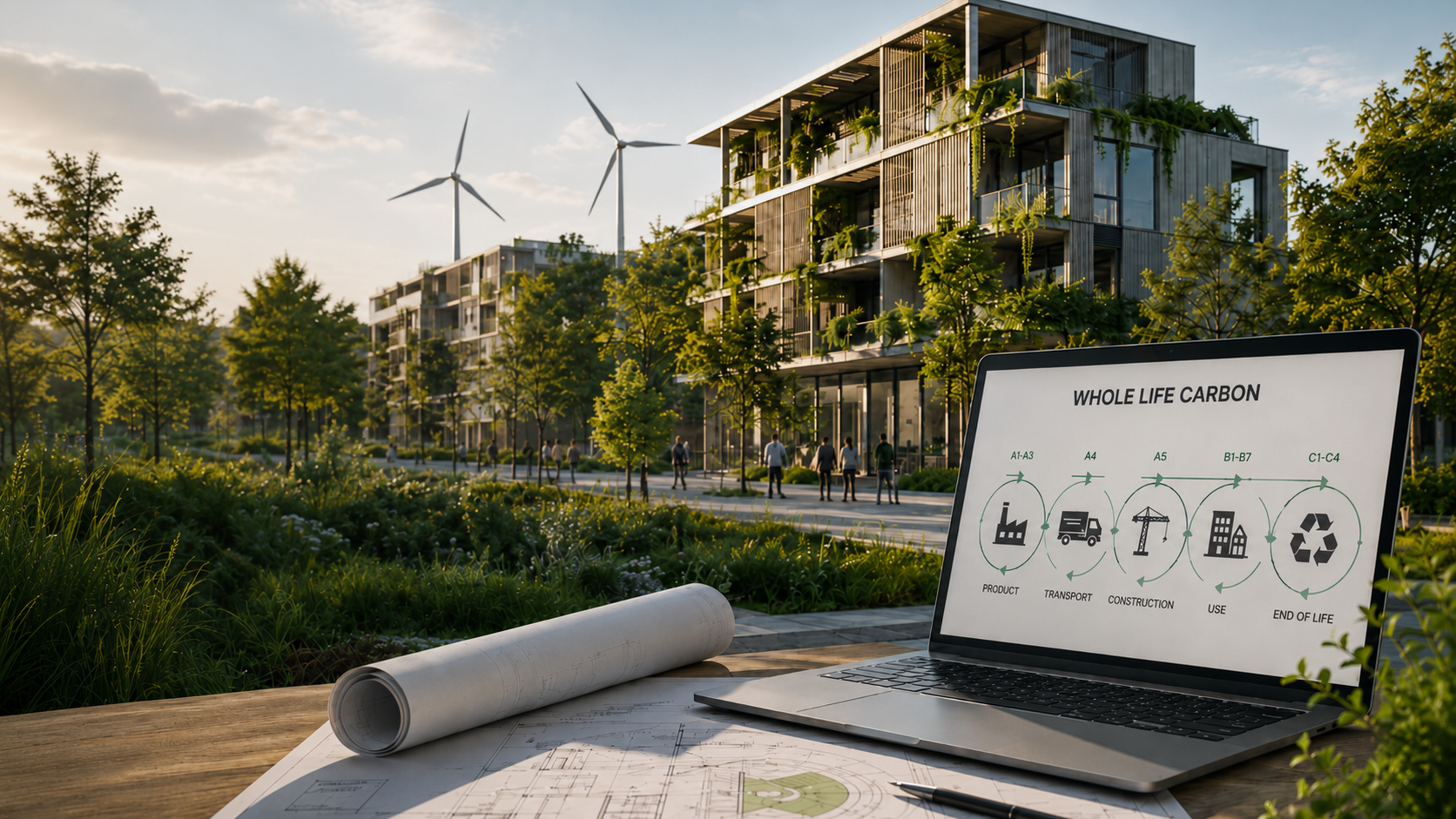
For years, the conversation around sustainable buildings has been dominated by one question:
"How much energy will this building use?"
It's a fair question. Energy efficiency remains a critical part of reducing carbon emissions and achieving net zero targets.
But it's no longer the only question that matters.
Increasingly, developers, housing providers, local authorities and investors are being asked something much broader:
"What is the carbon impact of this asset across its entire life cycle?"
That's where Whole Life Carbon Assessments (WLCA) come in.
And if it feels like you're hearing the term more often than ever before, you're not imagining it.
The built environment is undergoing a fundamental shift in how carbon performance is measured, reported and managed.
Looking Beyond Operational Carbon
Traditionally, building sustainability has focused heavily on operational carbon – the emissions generated from heating, cooling, lighting and powering a building during its use.
Improving operational performance remains essential. However, as buildings become more energy efficient, another source of emissions is becoming impossible to ignore.
Embodied carbon.
Embodied carbon includes the emissions associated with extracting raw materials, manufacturing products, transporting materials, constructing buildings, maintaining them over time and eventually demolishing or disposing of them.
In many projects, these emissions occur long before a building is occupied.
In fact, some of the largest carbon impacts a building will ever have may already be locked in by the time practical completion is achieved.
That's a challenge for organisations committed to reducing carbon emissions. But it's also an opportunity to make better decisions earlier in the process.
What Exactly Is a Whole Life Carbon Assessment?
A Whole Life Carbon Assessment measures the carbon emissions associated with an asset throughout its entire life cycle.
Rather than looking at a single stage in isolation, it provides a complete picture of carbon impacts from cradle to grave.
This typically includes:
Material extraction and manufacturing (A1-A3)
Transportation and logistics (A4)
Construction activities (A5)
Building operation and In-use emissions (B1, B6-B7)
Maintenance and replacement cycles (B2-B4)
Refurbishment works (B5)
End-of-life demolition and disposal (C1-C4)
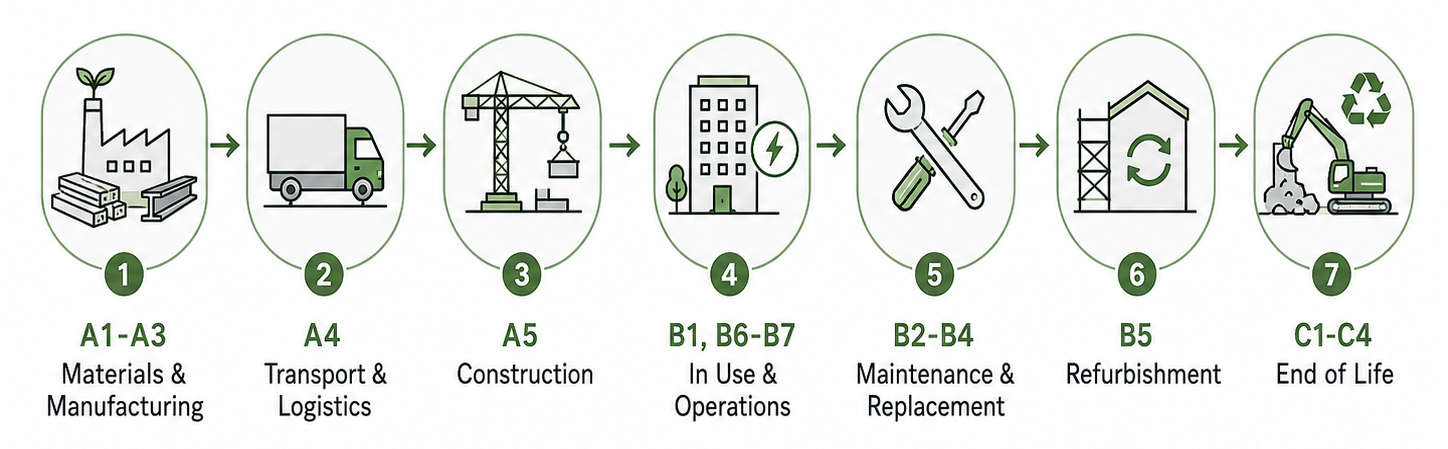
WLCA measures carbon emissions from cradle to grave, helping teams compare options and reduce impact early
The result is a much more comprehensive understanding of a project's environmental impact.
More importantly, it allows project teams to compare options, identify opportunities for carbon reduction and make informed decisions based on evidence rather than assumptions.
At practical completion, life cycle stages A1-A5 and B1 are typically based on as-built data, but others remain based on estimates, assumptions, and default carbon rates. WLCAs should therefore become a live data model upon practical completion, with live, actual, data plugged into the assessment once a building is operational, and default rates can be overwritten. A truer picture of the assets whole life carbon can be achieved.
Why Are More Organisations Being Asked for One?
There isn't a single answer.
Instead, several industry trends are converging at the same time.
Planning Requirements Are Evolving
Planning authorities are increasingly looking beyond operational energy performance when assessing development proposals.
Many organisations are now expected to demonstrate how carbon has been considered throughout the design process, particularly on larger or strategically important projects.
A Whole Life Carbon Assessment provides a structured way to evidence that approach.
Net Zero Commitments Need Better Data
Many organisations have made ambitious net zero commitments.
The challenge comes when turning those commitments into practical action.
You can't manage what you don't measure.
Without understanding where life cycle emissions occur, it's difficult to identify meaningful opportunities for reduction.
A WLCA helps bridge the gap between aspiration and delivery.
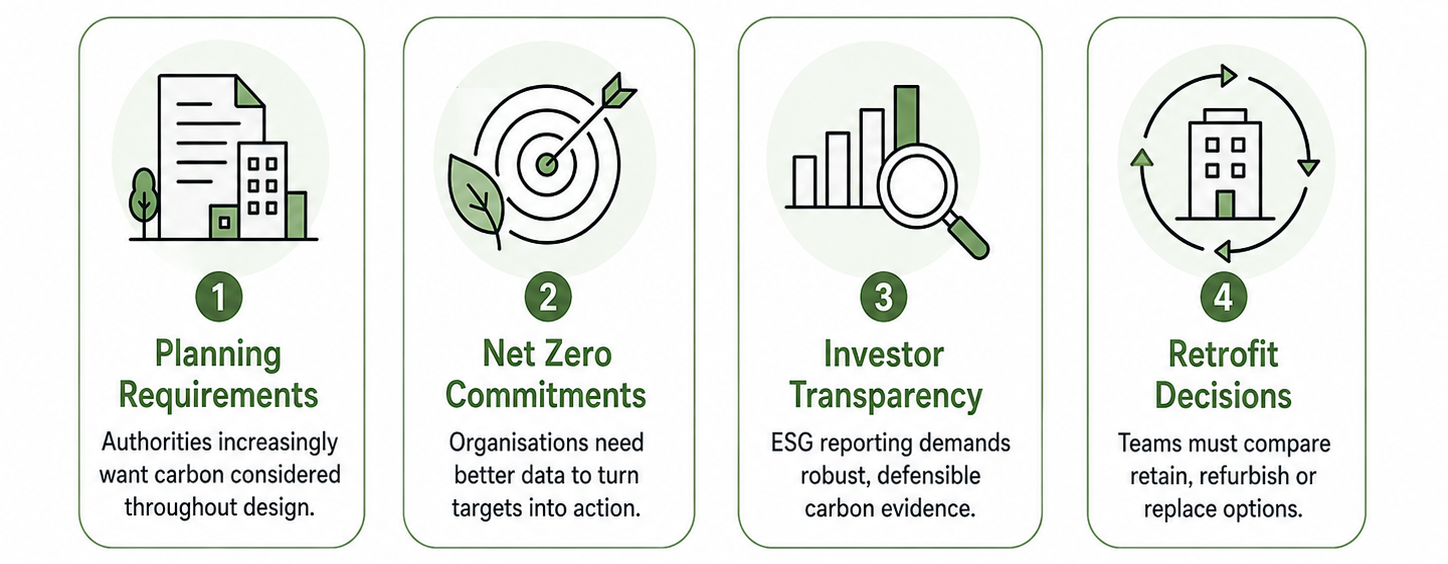
Regulation, ESG expectations and strategic carbon decisions are making WLCAs business as usual
Investors and Stakeholders Expect Transparency
Environmental, Social and Governance (ESG) reporting is becoming increasingly sophisticated.
Investors, funders and stakeholders are asking tougher questions about sustainability performance and carbon accountability.
Organisations need robust, defensible data to support their claims.
Whole Life Carbon Assessments provide that evidence base.
Retrofit Decisions Are Under Greater Scrutiny
One of the most important conversations happening across the built environment today is whether existing assets should be retained, refurbished or replaced.
Historically, decisions have often been driven by cost, condition or operational efficiency.
Now carbon is becoming a critical part of that equation.
A Whole Life Carbon Assessment enables organisations to compare options and understand the carbon implications of each approach.
Sometimes the results challenge conventional thinking.
The Biggest Benefit? Better Decision Making
At Mainer, we often see organisations assume that carbon assessments are primarily about compliance.
Their greatest value is often strategic.
A robust Whole Life Carbon Assessment helps answer questions such as:
Should we retrofit or rebuild?
Which design option has the lowest life cycle impact?
Where are the biggest carbon hotspots within the project?
Which materials deliver the greatest reduction opportunities?
How can carbon objectives be balanced with cost and performance?
These are business decisions as much as sustainability decisions.
The organisations that are getting ahead are those using carbon data to inform strategy rather than simply report against it.
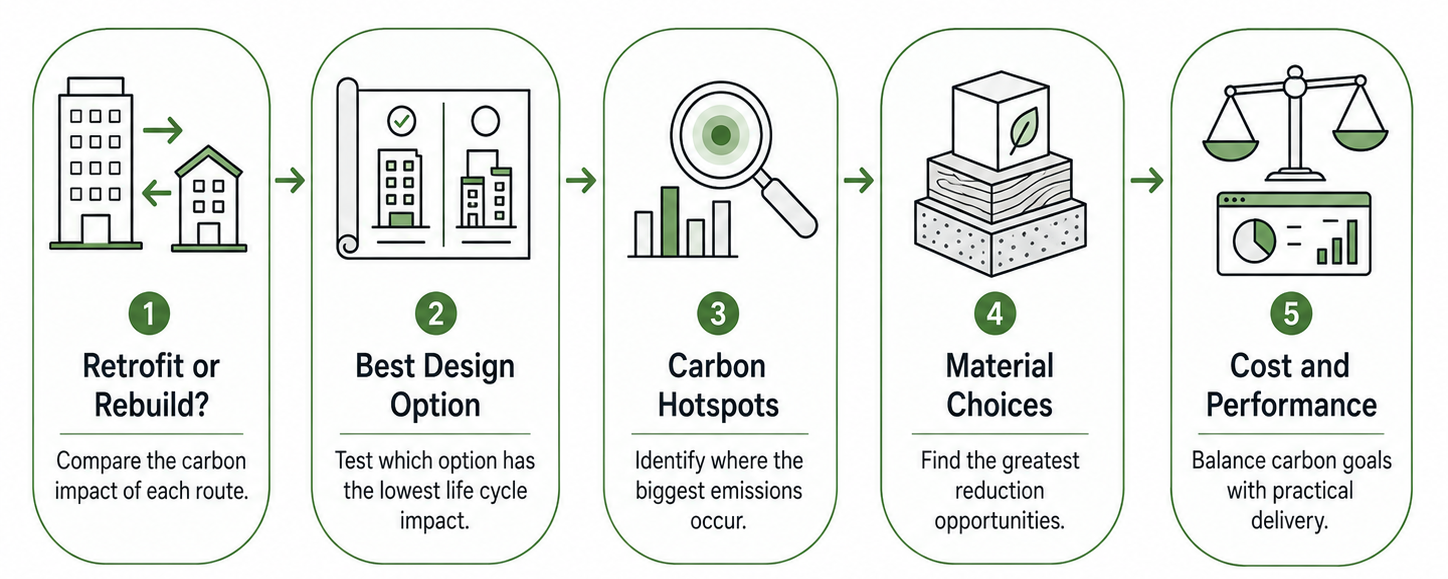
Better data supports compliance, strategy and better outcomes
Acknowledging Whole Life Carbon Is Becoming Business as Usual
There was a time when energy modelling was considered a specialist requirement.
Today it's a standard part of project delivery.
Whole Life Carbon Assessments are following a similar trajectory.
As regulations evolve, stakeholder expectations increase and net zero commitments mature, life cycle carbon data is becoming a core component of decision-making across the built environment.
The question is no longer whether organisations should understand their whole life carbon impacts.
It's how soon they can start using that insight to create better outcomes.
How Mainer Can Help
Whole Life Carbon Assessments are most valuable when they influence decisions early.
Our team works with developers, housing providers, contractors and asset owners to understand life cycle carbon impacts, identify reduction opportunities and support informed decision-making throughout the project life cycle.
Whether you're evaluating a new development, considering a retrofit programme or strengthening your ESG reporting, we can help you understand where carbon occurs, why it matters and what to do next.
Because better data doesn't just support compliance.
It supports better decisions.
Planning a development, retrofit programme or asset strategy review?
Contact us at hello@mainer.co.uk about how a Whole Life Carbon Assessment can support your project objectives.
Please click below for more information on Mainer’s Services:

LCA

EIA

BREEAM

Building Physics

Fitwel

Scope 3 Emissions

Planning Statements

ESG